
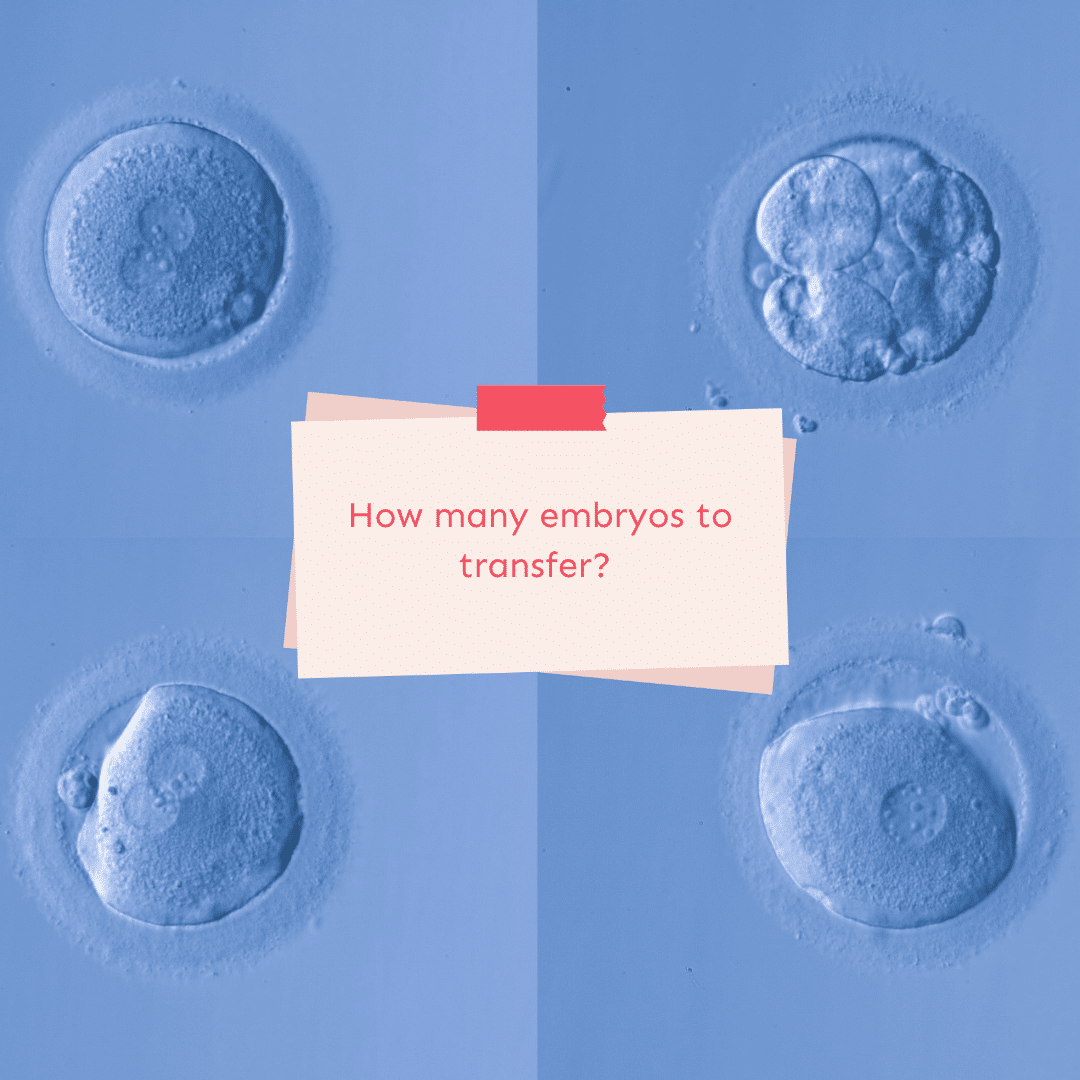
How many embryos to transfer? Number of embryo limits by country
How many embryos to transfer depends on the country, the clinic and your age. Some countries limit it by law: Germany and Spain allow at most three embryos per transfer. Others, like Switzerland, set no legal limit and leave the decision to you and your doctor. Medical guidelines are stricter than most laws. The European society ESHRE recommends transferring one embryo as the standard whenever more than one is available, because multiple pregnancies carry higher risks for mother and children. Before you book, ask your clinic how many embryos it transfers at your age and who makes the decision.
In Germany, the law allows up to three embryos per transfer. The European society for reproductive medicine, ESHRE, recommends one embryo as the standard whenever more than one is available. Both statements are true at the same time, and this gap is the reason for this article.
If you plan IVF abroad, you will meet this gap in the clinic. In some countries the law decides how many embryos may be transferred. In others no law names a number, and a guideline, the clinic or you decide. The same woman can hear “one” in one country and “two” in the next, and both clinics are right under their own rules.
I am not a doctor, so I do not explain the medicine. This article shows what the rules are by country, who decides, and what to ask your clinic before you pay.
How Many Embryos Are Transferred in One IVF Cycle
The number of embryos you can have transferred in one IVF cycle is not only a medical question. It depends on the embryos you have, your age, the rules of the country and what the clinic is used to doing. The guidelines of the big societies are clearer than most laws, so they are a good place to start.
Single Embryo Transfer and Elective Single-Embryo Transfer
Single embryo transfer means that one embryo is transferred in a cycle. In elective single-embryo transfer, often called eSET, you choose to transfer only one embryo even though more than one good embryo is available. The other embryos are usually frozen and used later in a frozen embryo transfer.
The European society ESHRE made this its standard in its 2023 guideline on the number of embryos to transfer, published in February 2024. It recommends eSET whenever more than one embryo is available. Women under 38 should receive eSET, and the guideline recommends it for women of 38 and older too, with weaker evidence. For donor eggs, donated embryos and gestational carriers, ESHRE says only a single embryo should be transferred. For vitrified and warmed blastocysts, ESHRE also advises a single transfer, whatever the quality of the blastocyst.
Double Embryo Transfer and Multiple Embryo Transfer
Double embryo transfer means two embryos are transferred at once. The ESHRE guideline does not name any situation in which this is clearly better than transferring one. It notes that clinics sometimes choose it when several poor prognostic factors come together, but it does not endorse it. Factors such as earlier failed cycles, the duration of infertility or the quality of the embryo should not decide alone. Transferring more than two embryos is not recommended.
The American Society for Reproductive Medicine and the Society for Assisted Reproductive Technology give a table of upper limits. Their 2021 committee opinion says that a euploid embryo, meaning an embryo with a normal chromosome count, should be transferred one at a time at any age. For other embryos, the limit depends on the stage of the embryo and on your age:
| Embryos | Under 35 | 35 to 37 | 38 to 40 | 41 to 42 |
|---|---|---|---|---|
| Cleavage stage, other favorable | 1 | 1 | up to 3 | up to 4 |
| Cleavage stage, not euploid or favorable | up to 2 | up to 3 | up to 4 | up to 5 |
| Blastocyst, other favorable | 1 | 1 | up to 2 | up to 3 |
| Blastocyst, not euploid or favorable | up to 2 | up to 2 | up to 3 | up to 3 |
These are recommendations of a professional society in the US, not law. For women of 43 and older using their own eggs, the committee says there are too few data to set a limit.
How Pregnancy Rate and Birth Rate Change With One or Two Embryos
A second embryo does raise your chance in one fresh cycle, but not by double, and it comes with a much higher risk of twins. A Cochrane review of 2020 compared the two policies. For a woman with a 46% chance of a live birth after one fresh double transfer, the chance after one fresh single transfer is 27% to 35%. The multiple pregnancy rate falls from 15% to between 2% and 4%. The authors rate the evidence as low to moderate quality, and it concerns mainly younger women with a good prognosis.
The picture changes when you count the frozen embryos too. If you repeat single transfers with your remaining embryos, the live birth rate is similar to one double transfer, between 34% and 46% against 42%, and the multiple pregnancy rate is between 0% and 3% instead of 13%. This is the logic behind the ESHRE and ASRM guidelines: the second embryo is not wasted, it is used in the next transfer. The ASRM opinion adds that a single euploid blastocyst gave a pregnancy rate similar to two untested blastocysts, with a dramatically lower risk of twins.
Countries that moved to single transfer show the effect in their numbers. In the UK, the multiple birth rate from IVF fell from around 28% in the early 1990s to 6% in 2019. In Germany, the multiple birth rate after a fresh transfer fell from 22.0% in 2017 to 9.3% in 2023, and the register attributes this to clinics choosing single transfers voluntarily.

Why Clinics Reduce the Number of Embryos to Transfer
Clinics have not reduced the number of embryos to make treatment harder for you. They did it because the number of embryos transferred is the one factor in IVF that the clinic and the patient can control, and it decides whether you carry one baby or two.
Multiple Pregnancies and Multiple Birth Rates
Transferring more than one embryo raises the chance of a multiple pregnancy, meaning twins or more. The ESHRE patient leaflet on embryo transfer says that babies from multiple pregnancies are more likely to have a low birth weight, and that multiple pregnancies carry a higher risk of preterm birth. For the mother, the leaflet names a higher risk of preeclampsia and gestational diabetes. A systematic review of 60 studies (Eapen et al., Fertility and Sterility, 2020) found the same pattern: twin pregnancies carry higher risks for the woman, such as preterm labor, preeclampsia and gestational diabetes, and for the babies, such as preterm birth, low birth weight and perinatal death.
Many people see twins as a good result of IVF, two children from one cycle. The guidelines see it as the most common avoidable complication of treatment. The ASRM opinion points out that multifetal pregnancy reduction, the procedure to reduce a multiple pregnancy, is not a real solution. It can lead to the loss of all fetuses and does not remove the risks of a multiple pregnancy.
The numbers show how much the transfer policy matters. In the US, SART data from 2017 show that 12.4% of women under 38 with a successful IVF cycle had a twin pregnancy. In 2014 it was 23%. This drop did not come from better medicine alone, it came from clinics transferring fewer embryos.
Embryo Quality and the Decision on How Many Embryos to Transfer
The more reliable the embryo, the less sense a second one makes. The ASRM opinion says that the transfer of a euploid embryo, an embryo with a normal number of chromosomes, should be limited to one, regardless of the woman’s age. A euploid embryo already has a high chance to implant, so a second embryo mostly adds the risk of twins.
Age works in the same direction. ASRM strongly encourages a single embryo transfer for women under 35 and asks women aged 35 to 37 to strongly consider it. Without data from the clinic itself, ASRM allows more embryos only for women aged 38 and older with a favorable prognosis: up to two blastocysts for ages 38 to 40, and up to three blastocysts for ages 41 and 42. A blastocyst is an embryo grown for five or six days, and the limits are higher for the earlier cleavage stage because those embryos implant less often. For women aged 43 and older using their own eggs, the opinion says there are not enough data to set a limit and advises caution.
ESHRE goes further on the question of age. Its patient leaflet states that only elective single embryo transfer should be performed for women under 38, and that women over 38 also benefit from it, because the cumulative live birth rate is similar after single and double transfer while complications increase with age. ESHRE also states that age, embryo quality, medical history and previous IVF results should not be used as reasons to choose a double transfer over a single one. The number of embryos should depend on how many embryos you have and how good they are, not on how well your ovaries responded.
Embryo Transfer Limits by Country
The rules on how many embryos can be transferred differ more than most patients expect. Some countries write a number into the law and punish a breach. Others set a general standard, and in some the number is left to the clinic. Before the list, one point that sources often mix up: the number of embryos a clinic may create is not the same as the number it may transfer. The countries below are sorted by what the law says about the transfer itself. The information is current as of October 2026, and laws change, so confirm the rule with your clinic before you travel.
Countries With a Legal Limit on the Number of Embryos to Transfer
Germany has the best-known rule. The Embryo Protection Act makes it a criminal offence to transfer more than 3 embryos to a woman within one cycle, with up to 3 years in prison or a fine. The limit does not change with age and has stood since 1990. Clinics stay well below it: the multiple birth rate after a fresh transfer fell from 22.0% in 2017 to 9.3% in 2023.
Spain sets a flat limit of 3 embryos per woman and cycle in Law 14/2006, again with no age variation. Exceeding it is an administrative infraction with a fine of EUR 1’001 to EUR 10’000. In practice single embryo transfer is now used in 65% to 90% of cycles, depending on the type of cycle, and triple transfers are down to 0.2% to 0.6%.
The Republic of Cyprus has the strictest law of the destinations most patients look at. Under Law N.69(I)/2015, women under 39 may receive 1 embryo in the first two cycles and 2 embryos from the third cycle onward. Women aged 39 and over may receive up to 2. A breach is a criminal offence, with up to 2 years in prison and/or a fine of up to EUR 100’000. Some clinic websites state different numbers, so check the statute and not the marketing page.
Greece allows up to 3 embryos for women aged 40 or under and up to 4 for women over 40 under Law 3305/2005. As far as I can tell this is still current, but the consolidated text after the latest amendments has not been verified.
Turkey set an age-based limit in a 2010 regulation: 1 embryo for women under 35 in the first two attempts, 2 embryos from the third attempt, and up to 2 embryos for women aged 35 and over. A 2021 study still describes these thresholds as in force, but the current text of the regulation could not be located, so ask the clinic to show you the rule it applies.
Countries Where Guidelines Decide, Not the Law
Switzerland limits the creation of embryos, not the transfer. The law allows 12 embryos to be developed per cycle, up from 3 before September 2017, and leaves the number to transfer to the physician together with the couple. The Swiss society for gynaecology (SGGG) advises single embryo transfer in its 2020 expert letter, especially for younger patients and higher-quality blastocysts, but this is professional guidance, not law.
Austria sets a standard instead of a number. The law allows only as many embryos to be transferred as are necessary for a promising and reasonable treatment, with a fine of up to EUR 50’000 for a breach. The figure of 3 embryos that is often quoted for Austria is not in the law. Registry data for 2024 show 91% single transfers and 9% double transfers.
Denmark has no number in its law. The health authority’s guidance sets 1 embryo as the norm, up to 2 in special cases and never 3. The multiple pregnancy rate after IVF and ICSI fell from 10.9% in 2014 to between 3.8% and 4.2% in 2019, which suggests clinics follow the guidance closely.
The United Kingdom sets no number in the Human Fertilisation and Embryology Act either. According to available information, the HFEA Code of Practice allows 2 embryos for women under 40 and 3 for women aged 40 and over. Breaching the Code is not an offence in itself, but it counts when the HFEA reviews a clinic’s licence. The NHS guidance in England (NICE) is a different document with stricter, age-dependent advice and should not be mixed with the HFEA figures.
Countries With No Clear Limit
The Czech Republic has no numeric limit in its Assisted Reproduction Act. The number depends on embryo quality, your age and the clinic’s decision.
Portugal names a standard in Law 32/2006: the number of embryos must be the number considered necessary for success, while preventing a multiple pregnancy. No sanction is attached to this rule, so in practice only the physician’s judgment applies.
Poland limits the number of eggs that may be fertilised, not the number of embryos transferred. The baseline is 6 eggs per IVF attempt, with exceptions for women aged 35 and over, for medical reasons and after two unsuccessful attempts. No transfer number appears anywhere in the law, so the clinic decides.
For North Cyprus, according to available information, a maximum of 3 embryos may be transferred. This is not confirmed against the legal text, so ask the clinic which rule it follows and ask for it in writing.
A country without a limit is not a country where every clinic transfers as many embryos as it likes. In the Netherlands, for example, no number appears in the law, yet the twin pregnancy rate fell from 21.7% in 2003 to around 2.8% in 2021. What counts in the end is the policy of the clinic you choose, which is the subject of the questions later in this article.
“Many patients think a second embryo doubles their chance. It does not. There are good reasons why the guidelines ask for one embryo at a time, and I want patients to understand them before they decide.“
Nathalie Wiederkehr
Who Decides How Many Embryos to Transfer, You or the Clinic
In practice it is a shared decision, but the two sides do not carry the same weight. The law or the guidelines set the outer limit, the clinic decides what is medically justified within it, and you decide what you accept. ESHRE asks for shared decision-making and says patients should discuss their individual chances, risks, preferences and costs with their fertility specialist.
What the Clinic Decides Based on Your Age and Embryo Quality
The clinic starts from the facts that the guidelines name: your age, how many embryos you have and how good they are. ASRM adds the prognosis. A young woman who expects one or more high-quality embryos for freezing, or who has had a live birth after IVF, has a favorable prognosis. A woman without a favorable prognosis may receive one additional embryo within the ASRM limits, after counseling about the risk of twins. If a medical condition makes a multiple pregnancy dangerous, ASRM says only one embryo should be transferred.
Some countries write this process into the rules. In France, the couple, the clinician and the biologist decide the number together, based on embryo quality, previous attempts, age and medical history. The aim is to stay at two embryos or fewer, and every case above two must be justified in the medical file. In Sweden, the clinic must inform and counsel you about the risks of transferring more than one embryo. In Germany, a guideline of the medical association requires the clinic to document the maximum number for your case as part of the informed consent. In Lithuania, the legal limit of 3 embryos must be stated in every consent form.
What You Can Ask For, and What You Cannot
You can always ask for fewer embryos. A single embryo transfer is allowed in every country covered above, and the ESHRE leaflet says that for women with high-quality embryos the success rate of a single transfer is comparable to a double transfer, while the cumulative birth rate is usually similar or higher.
You cannot ask for more than the law allows. In Germany, Spain, the Republic of Cyprus and the other countries with a legal limit, the clinic cannot transfer more than the statute permits, even with your consent, because the breach is the clinic’s offence. In countries with a standard or guidance instead of a number, such as Austria or Denmark, the clinic has to justify why a higher number is medically necessary.
The harder case is the country without a clear limit. There, no law protects you from a transfer policy that is too aggressive, and no law stops a clinic from refusing a second embryo if you want one. The only protection is a clinic that follows the guidelines and tells you its policy before you pay.

Single Embryo Transfer Abroad: What to Ask Your Clinic
The clinic’s own policy matters more than the country’s law, because most laws leave a wide space. Ask these questions before you pay a deposit, and ask for the answers in writing.
Questions About the Number of Embryos
Ask how many embryos the clinic usually transfers for a woman of your age with your embryo quality. A clinic that answers with a number and gives reasons works from a policy. A clinic that says “it depends” and nothing more leaves the decision open until the day of the transfer.
Ask whether the clinic has a written single embryo transfer policy, and under which conditions it would transfer two embryos. The guidelines give you the standard to measure against: ESHRE says that age, embryo quality, medical history and earlier IVF results should not be used as reasons to choose a double transfer, and ASRM limits the transfer of a euploid embryo to one. If the clinic transfers two in a case where the guidelines say one, ask it to explain why.
Ask what the legal limit in that country is and whether the clinic follows it. As the country section shows, the numbers in the law and the numbers on clinic websites sometimes differ.
Ask whether the clinic offers testing of the embryos for chromosome problems before the transfer. A tested embryo has a higher chance to implant, which is the reason ASRM limits the transfer of a euploid embryo to one. If the clinic offers it, ask which embryos are tested and what the test costs you in time and in the number of embryos available.
Questions About Success Rates and Frozen Embryos
Ask for the live birth rate per transfer for your age group, not the pregnancy rate. A pregnancy rate counts early pregnancies that do not end in a birth. Then ask whether the rate refers to one cycle with all embryos or to one transfer, and whether the clinic can show you the cumulative live birth rate across the fresh transfer and the frozen transfers that follow. This is the number that matters if you plan single transfers, because the Cochrane data above show that the cumulative rate over repeated single transfers is close to one double transfer.
Ask for the clinic’s multiple pregnancy rate. It tells you how the clinic works in practice, whatever the law says. The UK regulator uses a target of 10% for the multiple birth rate, which gives you a benchmark to compare against. A clinic that cannot or will not give you this number has a reason.
Ask what happens to the embryos that are not transferred. Can they be frozen, for how long, and under which conditions can you keep them, move them or end the storage? Single embryo transfer only works as a strategy if the remaining embryos can be frozen and used later. This also matters if you plan to move the embryos to another clinic or country, which is a question of its own and depends on both countries.
“Do not choose a clinic by the legal limit of the country. A law that allows three embryos does not mean a good clinic transfers three.”
Nathalie Wiederkehr
Number of Embryos to Transfer, Frequently Asked Questions
Is single embryo transfer always better?
For most patients the guidelines say yes. ESHRE states that only elective single embryo transfer should be performed for women under 38, and that women over 38 also benefit from it, because the cumulative live birth rate is similar after single and double transfer while the complications increase. ASRM is more cautious for older women and allows more embryos for women aged 38 and over with a favorable prognosis, and it points out that there are not enough data to set a limit for women aged 43 and over using their own eggs. The decision depends on your age, your embryos and your medical history.
Can I choose to have two embryos transferred?
Only within the limit that applies. In countries with a legal limit, such as Germany, Spain or the Republic of Cyprus, the clinic cannot go above it, and in the Republic of Cyprus a woman under 39 can receive only one embryo in the first two cycles. In countries without a clear limit, the clinic sets its own policy and may follow the guidelines even when you ask for two. Ask the clinic for its policy before you book.
Does a single embryo transfer lower my chances?
In one fresh cycle, yes. The Cochrane review of 2020 gives the example of a woman with a 46% chance of a live birth after one double transfer, who has between 27% and 35% after one single transfer. If you repeat single transfers with your frozen embryos, the live birth rate is similar to one double transfer, with a much lower risk of twins. The data come mainly from younger women with a good prognosis.
How many embryos are transferred in IVF abroad?
It depends on the country and the clinic. Some countries cap the number by law, for example 3 in Germany and Spain, 1 or 2 depending on age and cycle in the Republic of Cyprus, and 3 or 4 depending on age in Greece. Others leave it to guidelines or to the clinic. Registry data show that practice is often below the legal limit: in Austria 91% of transfers in 2024 were single transfers, and in Spain single embryo transfer is now used in 65% to 90% of cycles.
What is the difference between creating and transferring embryos?
Creating means fertilising eggs in the laboratory. Transferring means placing an embryo in the uterus. Some laws limit one and not the other. Switzerland allows up to 12 embryos to be developed per cycle and leaves the number to transfer to the physician. Poland limits the eggs that may be fertilised, with a baseline of 6 per attempt, and sets no transfer number. When you read a limit online, check which of the two it describes.
Can I send my frozen embryos to another country?
It depends on the laws of both countries and on both clinics. Some countries restrict the import or export of embryos: in Latvia, the law lists the import and export of embryos among its bans. Even where it is allowed, the sending clinic and the receiving clinic both have to agree, and both usually require your written consent. Ask both clinics before you decide where to freeze your embryos, because moving them later is not always possible.
How I Can Help
If you are currently exploring which clinic or which country might be right for you, I am here to support you. I have been helping people navigate international clinics for many years, and often a short conversation already brings a lot of clarity. You can find all my current offers here. If you have any questions, feel free to reach out, I look forward to hearing from you.
Sources
Guidelines
- ESHRE Guideline Group on the Number of Embryos to Transfer. Number of embryos to transfer in ART, Human Reproduction 39(4), 2024
- ESHRE. Embryo transfer guideline, patient leaflet
- American Society for Reproductive Medicine. Guidance on the limits to the number of embryos to transfer, committee opinion 2021
- Swiss Society of Obstetrics and Gynaecology (SGGG). Expertenbrief Nr. 71, 2020
- Danish Health Authority (Sundhedsstyrelsen). Guidance VEJ nr. 9351, 2015
- NICE. Quality Standard QS73, Fertility problems
Studies
- Kamath MS et al. Number of embryos for transfer following in vitro fertilisation or intra-cytoplasmic sperm injection, Cochrane Database of Systematic Reviews 2020, CD003416.pub5
- Higher obstetric and perinatal risks for twins and the need for single embryo transfers in assisted reproduction (editorial summarising Eapen et al., Fertility and Sterility, 2020)
- HFEA. Fertility treatment 2019: trends and figures
- Sen et al. BMC Pregnancy and Childbirth 21:111, 2021
Laws
- Germany: Embryo Protection Act (Embryonenschutzgesetz), Section 1
- Spain: Law 14/2006 on assisted human reproduction techniques
- Switzerland: Reproductive Medicine Act (FMedG), SR 810.11
- United Kingdom: Human Fertilisation and Embryology Act 1990, section 25
- Portugal: Law 32/2006 on medically assisted procreation
- Poland: Infertility Treatment Act of 25 June 2015, Dz.U. 2015 poz. 1087
- Turkey: Regulation on assisted reproductive treatment practices and centres, Official Gazette 29135, 2014
- Republic of Cyprus: Law N.69(I)/2015, Article 28
- Greece: Law 3305/2005, Article 6
- Austria: Reproductive Medicine Act (Fortpflanzungsmedizingesetz), Sections 10 and 22
- Czech Republic: Act No. 373/2011 Sb. on specific health services
- France: Order of 11 April 2008 on good clinical and laboratory practice in assisted reproduction, Chapter III-2.3
- Sweden: Socialstyrelsen, SOSFS 2009:32, Chapter 4, Section 15
- Lithuania: Law on Assisted Reproduction XII-2608, Article 10
- Latvia: Sexual and Reproductive Health Law, Article 15
- Netherlands: Embryo Act (Embryowet)
Registers
- Netherlands: NVOG, IVF report 2021
- Germany: Deutsches IVF-Register, Annual Report 2024
- Austria: IVF Annual Report 2024, Gesundheit Österreich GmbH
- Spain: National Activity Registry, Spanish Fertility Society (SEF) and Ministry of Health
- Denmark: Danish Health Data Authority, Assisted reproduction 2016 and 2019